
)
Mobile game monetization strategies that work

When developing a mobile game, monetization should be part of the strategy from day one. In 2025, in-app purchase (IAP) revenue from mobile games across iOS and Android reached US$82 billion (+1.4% YoY), alongside 50 billion downloads and some 225,000 games released. There’s clearly a large, stable opportunity. But there’s also huge competition.
Today's most successful games rarely rely on a single revenue stream. Instead, they combine advertising, IAP, subscriptions, live events, and more to appeal to different player preferences. Some players never spend money but happily engage with rewarded ads. Others make occasional purchases, while loyal players may subscribe or invest in seasonal content.
The key is finding the right balance between monetization and player satisfaction. When monetization feels like a natural extension of gameplay, players are more likely to stay engaged and continue supporting your game over time. The right strategy will generate revenue while also shaping the player experience and creating high lifetime value (LTV) for all user segments.
What is mobile game monetization?
Mobile game monetization covers every mechanism a developer uses to generate revenue throughout a game's lifecycle. It starts with choosing a business model before launch, but it also includes how offers are presented, where ads appear, how players progress, and how revenue is optimized over time.
The most effective monetization strategies are built around player behaviour. Different audiences engage with games in different ways, so the right approach depends on factors such as genre, gameplay loop, and player motivation. A casual puzzle game, for example, may rely heavily on rewarded advertising, while a strategy game may generate more revenue through in-app purchases, battle passes, items, and recurring content.
Your game's economy also plays an important role. Virtual currencies, progression systems, and reward loops all influence how players interact with monetization. If resources are too scarce, purchases can feel mandatory. If everything is too easy to earn, premium content loses its appeal. Finding the right balance creates opportunities to monetize without undermining the core gameplay.
)
Poorly timed ads, frustrating paywalls, or offers that feel out of place can interrupt gameplay and make players less likely to return. Before deciding how your game will make money, think about what players will actually value. People are far more willing to spend when a purchase enhances an experience they're already enjoying than when it removes an artificial barrier. That principle should shape every monetization decision, whether you're introducing rewarded ads or premium content.
A monetization strategy shouldn't be treated as something that's fixed at launch. It should develop alongside the game as player behaviour becomes better understood.
Mobile game monetization models
There are several ways to monetize a mobile game, and each serves a different purpose. Some models are designed to generate revenue from a broad player base, while others focus on players who are willing to spend more over a longer period. Many of the most successful games combine multiple approaches, creating opportunities to monetize different player segments without relying too heavily on a single revenue stream. Others focus on one approach, though this is becoming less common.
)
Let’s explore the most popular and effective ways to monetize mobile games.
Ad-supported games
Advertising (ad revenue) remains one of the most widely used monetization models, particularly in free-to-play games. It allows developers to generate revenue from players who may never make a purchase, making it especially effective in casual and hyper casual genres with large audiences and a high volume of installs and turnover.
The format of an ad is just as important as its placement. Rewarded video has become the preferred choice because players opt in to watch an ad in exchange for something valuable, such as extra lives, in-game currency, items, or temporary boosts. This creates a clear value exchange instead of simply interrupting gameplay.
)
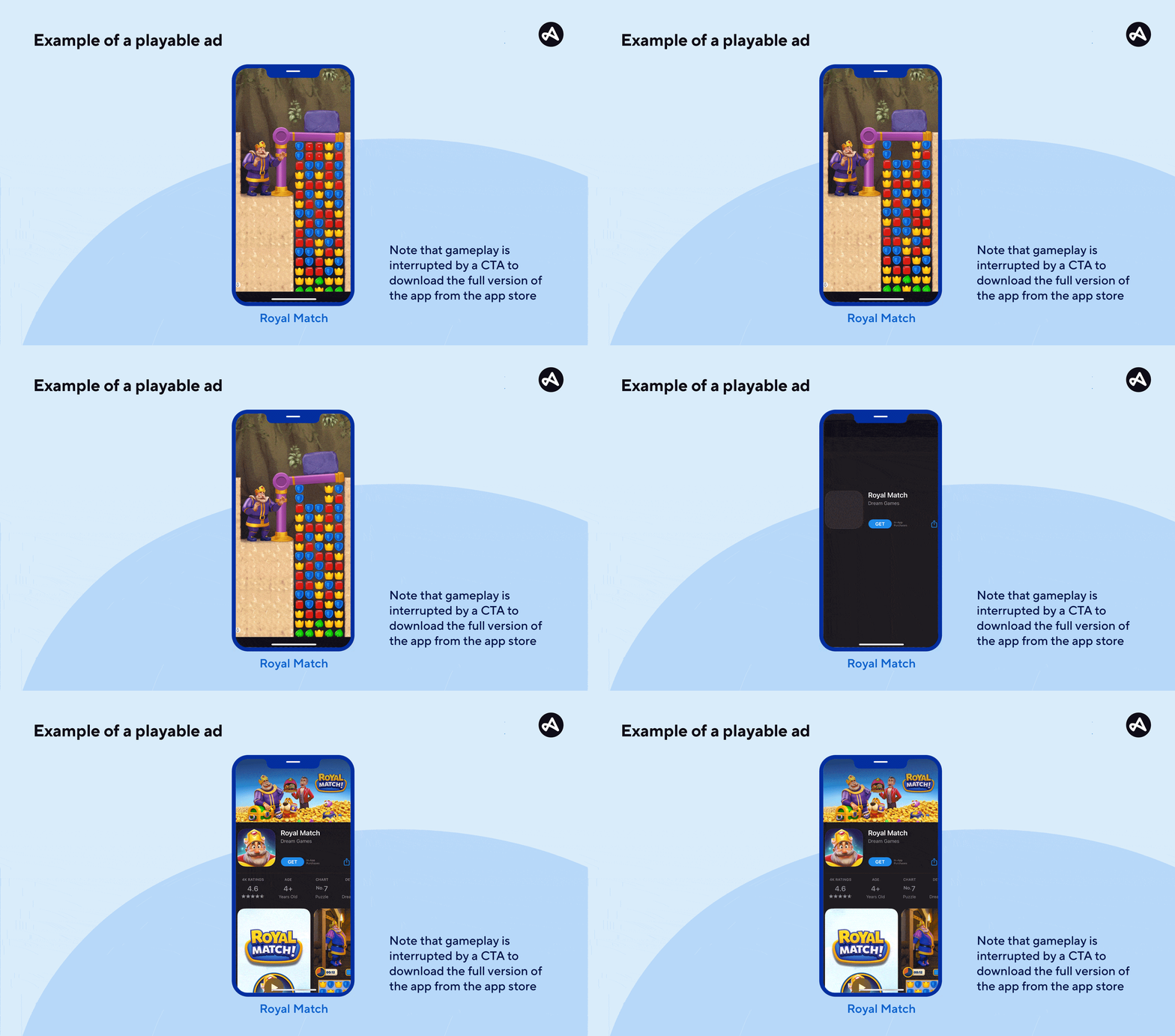
Playable ads are another popular format, giving players a chance to try another game before downloading it. Because users know what to expect, these ads often lead to higher-quality installs than traditional display advertising.
Interstitial and banner ads still have a place in some games, but they should be introduced carefully. Poor timing or excessive frequency can disrupt gameplay and reduce retention, ultimately limiting LTV.
In-app purchases
IAP remains the largest source of revenue across the mobile gaming industry. Rather than charging players to download a game, developers generate revenue by selling optional content that enhances the experience.
IAPs can include a mix of “consumables” and “non-consumables,” including virtual currencies, cosmetic items, character skins, expansion content, premium characters, and convenience features that reduce grinding or unlock additional gameplay. Limited-time bundles tied to seasonal events have also become a common way to encourage purchases without permanently discounting content.
)
A successful IAP strategy depends on a well-designed in-game economy. Players should feel that purchases offer genuine value, whether that's saving time, expanding gameplay or personalizing their experience. If progression feels artificially slowed simply to encourage spending, players are less likely to remain engaged over the long term.
Subscription models
Subscriptions create recurring revenue while giving players ongoing reasons to return.
Some games offer premium memberships that remove ads or provide monthly rewards. Others include exclusive cosmetics, bonus currency, more in-game items, or early access to new content. For developers with multiple titles, subscriptions can also encourage players to explore games across an entire portfolio.
)
Battle passes have become one of the most effective subscription-style mechanics. Players purchase access to a seasonal progression track and unlock rewards by completing objectives over a limited period. This creates a strong incentive to play consistently while providing developers with predictable recurring revenue.
Premium (paid) and freemium games
Charging an upfront price remains a viable option for games that deliver a complete experience from the moment they're downloaded. This approach is most common among premium indie titles, story-driven games, and established franchises with loyal audiences. Unlike freemium games, where players download the game for free and choose whether to spend later, premium games generate revenue from the initial purchase.
While premium games depend less on ongoing monetization, many continue to generate revenue through expansion packs, downloadable content, or optional cosmetic purchases introduced after launch.
Live operations
Monetization doesn't stop once a game launches. Live operations, often referred to as LiveOps or live-ops, have become a core part of keeping players engaged while creating new revenue opportunities throughout a game's lifecycle.
Regular content updates, seasonal events, limited-time collaborations, and exclusive rewards give players a reason to keep coming back. They also create natural moments to introduce battle passes and time-limited bundles without disrupting the core gameplay experience.
For developers, LiveOps provides a way to continually test new ideas and respond to player behaviour. A successful event can be expanded, while underperforming content can be refined or replaced. This ongoing approach helps maintain engagement and supports more sustainable monetization over time.
Learn more about live-ops and real-time growth.
Beyond the app stores: Third-party distribution and D2C
The way players purchase digital content is changing. Increasingly, developers are complementing app-store based IAP with direct-to-consumer (D2C) web stores that allow players to buy virtual currency, bundles, exclusive items, or any other purchasable content outside the game’s direct environment
These web stores often include incentives such as bonus currency, loyalty rewards, or exclusive extras that aren't available through traditional app marketplaces. The ideas is that they give developers greater control over pricing, promotions, purchase experiences, and customer relationships.
At the same time, changes to platform policies and the emergence of alternative app stores in some markets are giving developers more flexibility in how they distribute games and process payments. While these options won't suit every studio, they're becoming an increasingly important part of a broader monetization strategy.
)
AI and personalization
AI is becoming an increasingly critical tool for optimizing mobile game monetization when it comes to keeping pace and remaining competitive. Rather than introducing new revenue models, it helps developers understand player behaviour at a scale that's impossible to analyze manually.
AI models can process millions of gameplay events, purchase journeys, engagement signals, and events to identify patterns across different player segments. These insights help developers understand which players are most likely to convert, where users tend to disengage, which monetization mechanics are creating the strongest long-term value, and even which ad creatives mapped to specific segments result in the most effective conversion rates.
AI also supports faster experimentation. Developers can evaluate the impact of pricing changes, promotional campaigns, store layouts, and reward structures more efficiently, making it easier to refine monetization strategies over time. Instead of relying on intuition or time consuming, manual analysis, teams can prioritize decisions using data gathered across the entire player lifecycle, super fast.
Adjust’s AI Solutions, Growth Copilot and MCP, build on these capabilities by helping marketers and developers analyze campaign performance, identify high-value audiences, “talk” to their attribution data, and uncover opportunities to improve monetization outcomes.

Adjust AI Solutions
Best practices for mobile game monetization
A successful monetization strategy depends on more than choosing the right revenue model(s). How those mechanics are implemented has a direct impact on player engagement and long-term performance.
- Prioritize the player experience: Ads, offers, purchases, and external options should feel like a natural part of the game, not an interruption. Players are more likely to spend when monetization adds value rather than creating friction.
- Combine multiple revenue streams: Advertising, in-app purchases, paid modes, and subscriptions each appeal to different player segments. A hybrid approach helps maximize revenue while reducing reliance on a single monetization model.
- Use LiveOps to maintain engagement: Seasonal events, collaborations, and limited-time content give players a reason to return while creating natural opportunities to introduce new offers and rewards.
- Personalize where possible: Tailoring offers, promotions, experiences, and rewards to different player segments makes monetization more relevant and can improve conversion over time.
- Test and optimize continuously: Small adjustments to pricing, ad placements, timing, reward values, or store design can have a meaningful impact on engagement and revenue. Measure the results and continue iterating.
Measuring monetization success
Launching a monetization strategy is only the beginning. Measuring how players respond is what allows developers to improve outcomes..
Key metrics generally include LTV, average revenue per daily active user (ARPDAU), average revenue per paying user (ARPPU), retention, conversion rate, and return on ad spend (ROAS). Looking at these metrics by player cohort provides a clearer picture of which monetization mechanics are creating sustainable revenue and which need further optimisation.
Bringing monetization data together with user acquisition (UA) and engagement metrics also helps developers understand which channels attract their highest-value players, allowing them to invest more effectively in campaign level and across live operations.
As a mobile measurement partner (MMP), Adjust helps gaming marketers and developers connect user acquisition, engagement, channel, campaign, and monetization data to build a complete picture of player value. With powerful, AI-driven analytics and dashboards and industry-leading measurement and fraud prevention, you can easily identify your highest-value audiences and refine your entire marketing strategy for reliable, unbiased optimization of what really brings results.
To see first hand how Adjust can support your monetization efforts and grow your app business in general, request a demo today.
Be the first to know. Subscribe for monthly app insights.
Keep reading
